
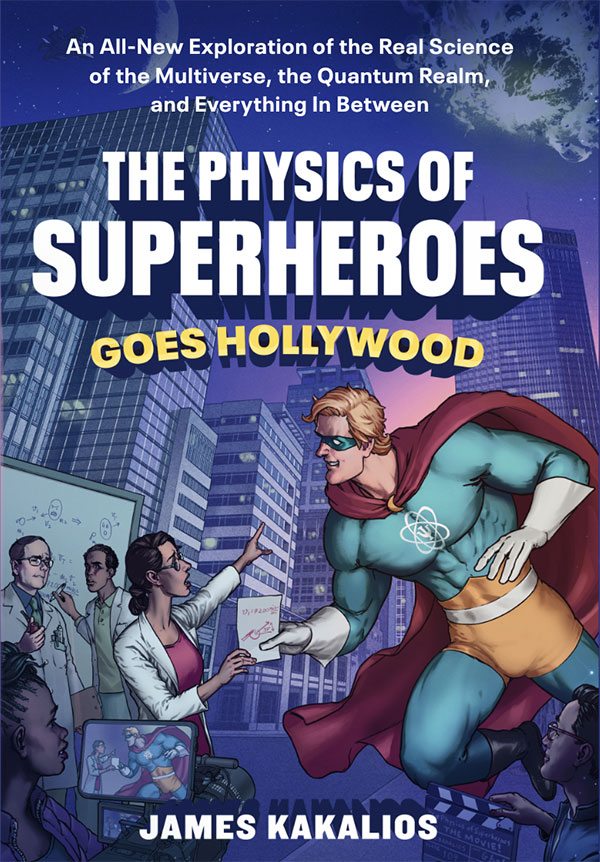
What if science-fiction was actually science-fact?
My first book The Physics of Superheroes, was published in 2005, three years before Iron Man and The Dark Knight lit the match that ignited the superhero explosion at the multiplex. In the All-New, All-Different The Physics of Superheroes Goes Hollywood I’ll consider concepts and situations in superhero movies and TV shows and examine the real-world physics that underlies these fictional scenarios.
While I don’t go to the movies with a pad of paper and a calculator, waiting for my physics-sense to start tingling, I’m nevertheless delighted whenever the characters on the screen, big or small, get their science right. It is just such examples, admittedly cherry-picked, that I will discuss in my new book.
In this new book, you, Fearless Reader, will learn the real physics underlying the multiverse (true to its name—there are different interpretations of what “multiverse” means); if there really is a Quantum Realm (yes); why someone the size of an ant can knock someone out with one punch (it involves the Higgs boson); whether nanotechnology can fabricate and alter Iron Man’s suit (not yet, but maybe soon); whether we can create fibers as strong as Spider-Man’s webbing (actually, scientists have made threads sixty times stronger); whether we can control devices just by thinking (yes); and the connection between the Infinity Stones and one of the greatest mathematical minds of the twentieth century (hint: she’s not Albert Einstein). This book will confirm what we all have long suspected—they couldn’t put it in a movie if it weren’t true!
Prepare to get educated in the nerdiest way possible.
Superheroes aren’t actually real, but physics definitely is. By asking how ideas from superhero stories can be related to real concepts in physics, we both learn a little science and appreciate the stories a little better. And when the explanations are offered by a writer as entertaining as Jim Kakalios, anyone can enjoy the wild ride.
- Sean Carroll, physics professor and author of The Biggest Ideas in the Universe
A must for anyone who is a fan of superhero movies and wishes to understand the imaginative science behind them.
- Paul Halpern, physics professor and author of The Allure of the Multiverse
Fantastic, amazing, and spectacularly well-researched, The Physics of Superheroes Goes Hollywood is an accessible and fascinating way to use fictional heroes to learn more about the real world we all share.
- Ryan North, author of How to Take Over the World
It’s easy to cynically handwave away superhero physics as ‘comic-book stuff.’ Kakalios does the hard and imaginative work of figuring out how the impossible could be possible using cutting-edge science. It’s smart and fun and a must-have.
- Mark Waid, writer of Superman: Birthright
NO ONE does this sort of material better than Professor James Kakalios. He writes in a crisp, engaging manner that stirs the emotions just as much as the intellect. More than once I teared up a little remembering the exact superhero touchstone moments he describes so beautifully. Highest recommendation.
- Gail Simone, comic book author and screenwriter, Wonder Woman, Deadpool, Uncanny X-Men
James Kakalios does a truly superheroic job in combining his love of superheroes with his passion for explaining the surprising and fascinating physics that underlies the world around us.
- Clifford V. Johnson, physics professor and author of The Dialogues: Conversations About the Nature of the Universe
To be released September 16, 2025.
Ask for it wherever books are sold or order your copy from an online retailer now.


